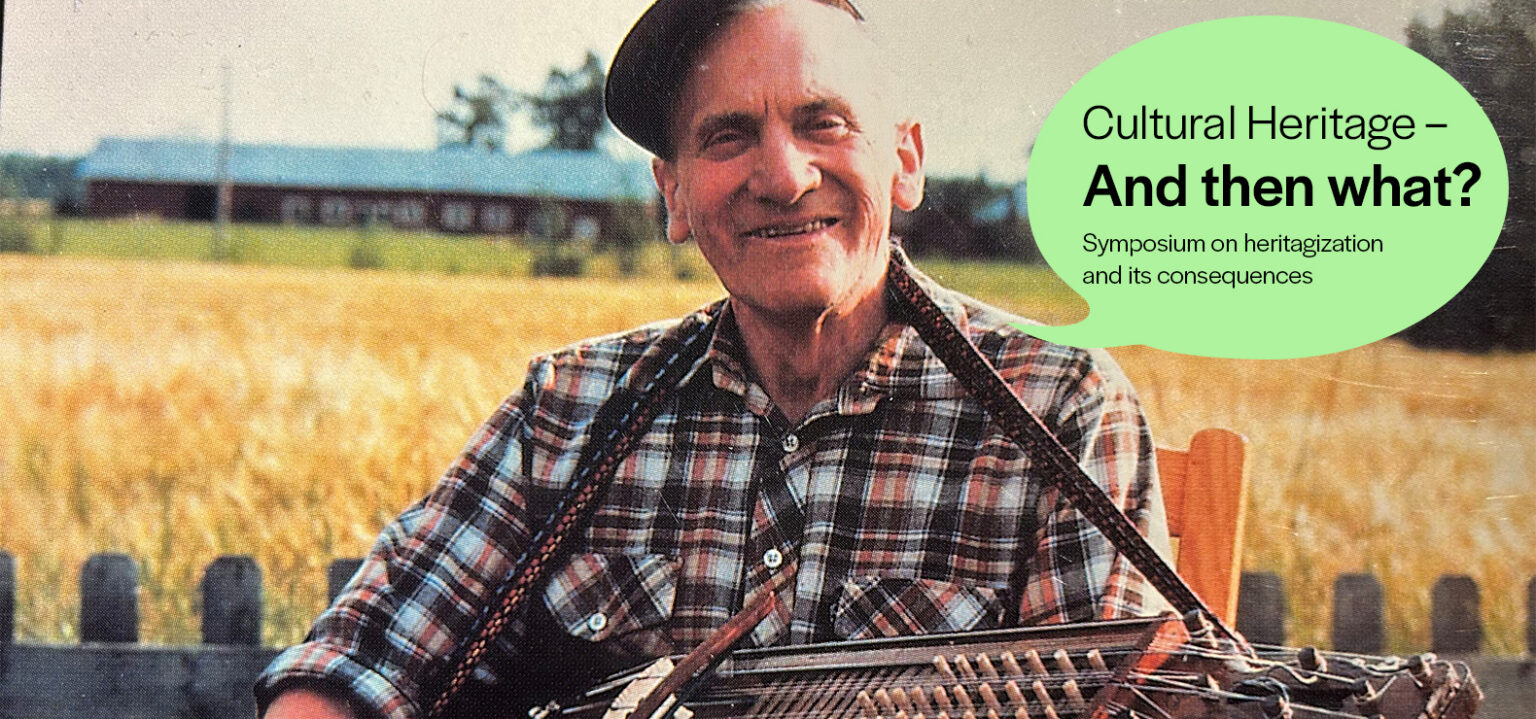
And then what?
What happens after something is granted cultural heritage status? Welcome to a symposium on the consequences of listings and inscriptions.
Program
The symposium is organized in collaboration with the National Collections of Music, Theatre and Dance, the Royal Gustavus Adolphus Academy, and the Institute for Language and Folklore.
It will take place over two days, 7–8 December 2026, at the Swedish Museum of Performing Arts in Stockholm. The symposium will be held in English and is open to the public, registration required.
Register by 1 December at owe.ronstrom@etnologi.uu.se.
Monday, 7 December
9:30 Registration and coffee
10:00–10:15 Welcome and introduction
Martin Sundin, Director General, Statens musikverk – National Collections of Music, Theatre and Dance.
Owe Ronström, Professor Emeritus in Ethnology, Uppsala University
10:15–11:15 Paper 1: Following UNESCOs concept across international, national and local levels.
Emilie Paaske Drachman, Research Librarian, Royal Danish Library
11:15–12:15 Paper 2 “The UNESCO process in Kaustinen, Finland: changing heritage discourses & competing political interests”.
Outi Valo, PhD, Finnish Folk Music Institute & University of the Arts Helsinki, Finland
12:15–12:45 Lunch break. (Sandwiches for registered participants provided by The National Collections of Music, Theatre and Dance.)
12:45–13:45 Panel 1: From nomination to inscription – and then what?
Panelists:
Tine Winther, Operations Manager at Sagobygden/Berättarnätet Kronoberg
Fredrik Leijonhuvud, Nordic steering committee for clinker-built boat traditions.
Outi Valo, PhD, Finnish Folk Music Institute & University of the Arts Helsinki, Finland
Olov Johansson, Nyckelharpa-musician and maker, composer.
Moderator: Charlotte Hyltén-Cavallius, Research Archivist, Institute for Language and Folklore.
13:45–14:00 Closing remarks
18:00 Dinner for invited guests
Tuesday, 8 December
9:00–10:00 Paper 3: Interrogating intangible cultural heritage: from discourses to dispositives.
Antti-Ville Villén, Professor, Cultural Study of Music, University of the Arts. Helsinki, Finland.
10:00–10:30 Coffee
10:30–11:30 Paper 4 Who Is Watching? Inscribed Elements, Institutional Capacities and the Actors of Safeguarding in Slovakia.
Jana Ambrózová, Musical anthropologist, singer and violinist, Faculty of Arts, Constantine the Philosopher University, Nitra, Slovakia / Institute of Ethnology and Social Anthropology, Slovak Academy of Sciences, Bratislava
11:30–12:30 Lunch. (Sandwiches for registered participants provided by The National Collections of Music, Theatre and Dance.)
12:30–14:00 Workshop
Olov Johansson, Nyckelharpa-musician and -maker, composer.
Mats Wester, Nyckelharpa-musician and -maker, music creator.
14:00–15:00 Panel 2: Medal or springboard – what could a UNESCO inscription lead to?
Panelists:
Maria Nyström, Senior advisor, Institute for Language and Folklore.
Martin Sundin, Director General, The National Collections of Music, Theatre and Dance.
Maria Wilenius, Secretary General Swedish National Commission for UNESCO
Emilie Paaske Drachman, Research Librarian, Royal Danish Library
Moderator: Dan Lundberg, Associate professor, Ethnomusicologist
15:00–15:30 Coffee
15:30–16:30 What next? Open discussion
Moderator: Owe Ronström, Professor Emeritus in Ethnology, Uppsala University
16:30 Closing